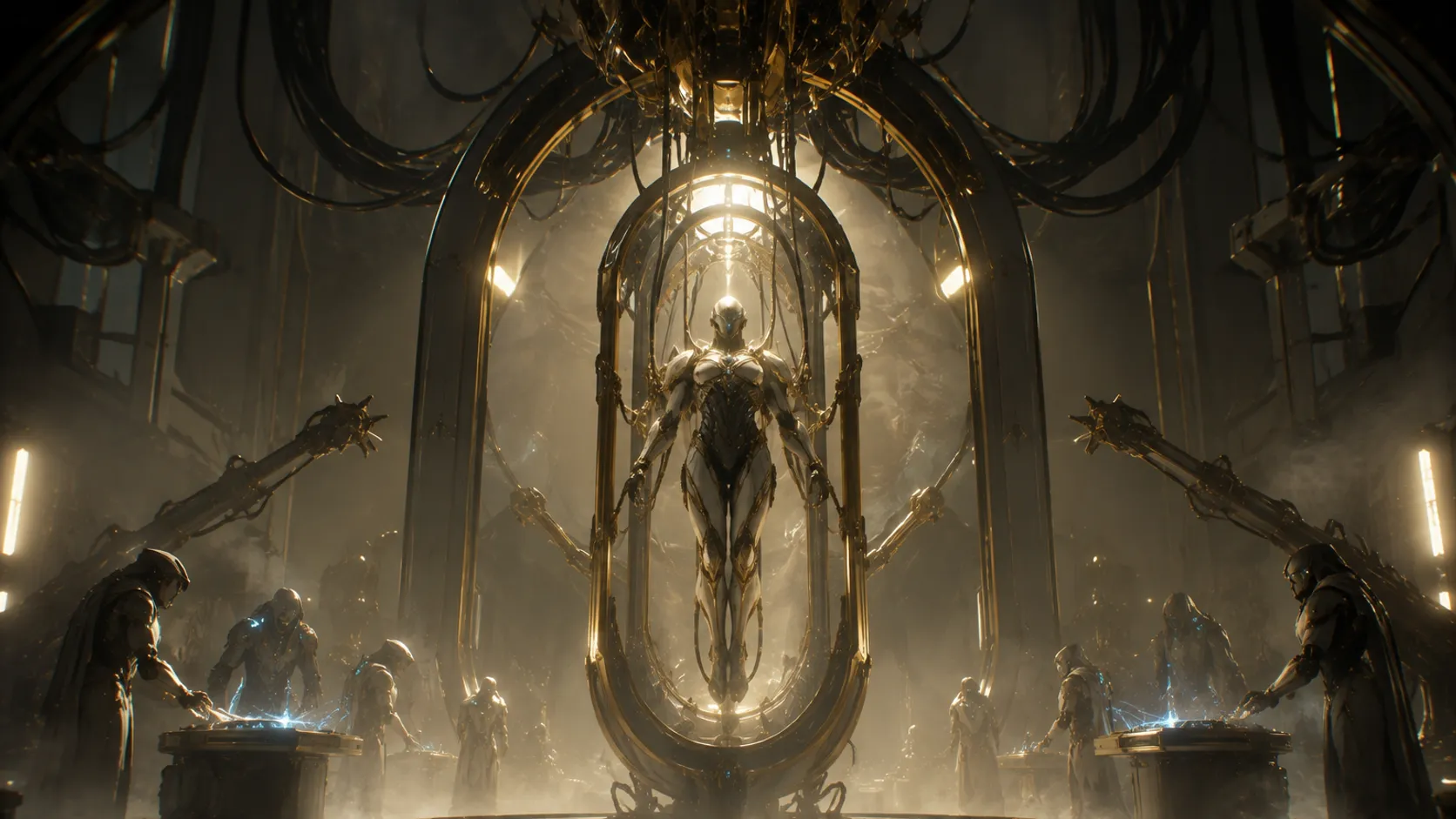
The Birth of the Warframe Project
Human beings, Infestation and bodies made for war
Learn how the Helminth process turned people into Warframes, and how the Orokin joined their failed soldiers to the Tenno.
- ERA
- The Old War
- PREREQUISITE
- Contains spoilers for The Sacrifice
The human beneath the steel
A Warframe is not armour. The first examples came from transforming chosen human beings with a particular Infestation strain called the Helminth. Skin became a sheath, organs became a combat system, and the body became an extraordinarily fast and durable weapon.
The Orokin assumed at first that these bodies would follow orders on their own. The pain of the transformation, the erased memories and the pressure of the Infestation instead left the subjects uncontrollable. The Warframe project was written off as a powerful but unmanageable failure.
What made the Helminth different?
Most forms of the Technocyte outbreak fold their target into a common Infested mass. The Helminth strain used in Warframe production, by contrast, was directed so as to convert a body into a specific combat form. Bone, muscle and organs became the infrastructure of new abilities while the outer surface formed biological armour as durable as metal.
Each Warframe’s theme of power is not merely a weapon bolted on afterwards; it is written into the way its body was transformed. Ember’s heat, Mag’s magnetism and Saryn’s toxins are different designs of the same biological system. When the Orokin turned those bodies into mass-producible blueprints, the Prime designs appeared — and, later, the copies we build today.
The first subjects of the transformation may have come from very different backgrounds: volunteer soldiers, people who were coerced, and people being punished. There is no single production story behind every Warframe. What they certainly share is a body of human origin turned into a combat form by way of the Helminth.
Ballas’s method
Rather than abandon the project, Ballas looked for a pilot who could control the pain. The Tenno’s talent for Transference could reach a Warframe’s mind. The children could feel the pain of bodies in which everyone else saw only a monster — and could quiet it.
NARRATIVE — What silenced a Warframe was not a harder chain. It was another mind that knew the same pain.
The story of Excalibur Umbra plainly shows that the human past inside a Warframe may not be wholly gone. However much individual consciousness survives from example to example in standard Warframe production, the origin is biological and human.
The limit Umbra reveals
Ballas transformed Umbra not only to make a warrior but to punish him. He left him a single searing memory in which he would relive his son’s death again and again. That is why Umbra moves independently, displays anger and carries a will separate from the Operator’s.
Umbra’s particular memory does not mean every standard Warframe holds the same degree of awareness. It does prove that a Warframe body cannot be described as an empty shell. The scene in The Second Dream in which a Warframe moves to protect the Operator likewise suggests the bond is more than remote command.
The Tenno’s success comes not from erasing that will but from being able to live with the pain the body carries. The approach the Operator offers Umbra in The Sacrifice makes it plain: the pain cannot be destroyed, but it can be carried together.
A second body
Asleep in the Reservoir, a Tenno entered a dream deep enough to believe they were the Warframe. They experienced the Warframe as the one walking, firing and being wounded on the battlefield. That secret both protected the Tenno and kept the enemy from finding their real centres.
When Warframe and Tenno joined, Void power that overcame Sentient adaptation met a biological body designed for war. The balance of the Old War shifted.
Blueprints and the Warframes of today
The Warframes a player builds in the Foundry are reconstructions of old design blueprints and biological materials. That process does not mean the historical first human is resurrected exactly, every time. While special examples like Umbra are re-formed with their own body and memory, most Warframes are new instances of a preserved combat form.
Prime Warframes are distinguished designs associated with Orokin aesthetics and technology. No single rule — “the first was always the Prime”, or “the ordinary version certainly came first” — can be applied to every character’s story; the game expands the origin of different Warframes separately through quests and Leverian records.
What did we learn in this chapter?
Warframes are not empty robots but biological war beings made from human bodies. What makes them effective is not their power alone but the bond they form with a Tenno. The next chapter explains why that bond is empathy rather than command.
BallasExcalibur UmbraOperator
OrokinTennoInfested
Origin SystemLua
HelminthInfestationWarframeTransference
Sources and verification
This account was prepared by cross-checking in-game records, official quest pages and the current WARFRAME Wiki.
CHAPTER COMPLETEYour reading progress has been saved on this device.