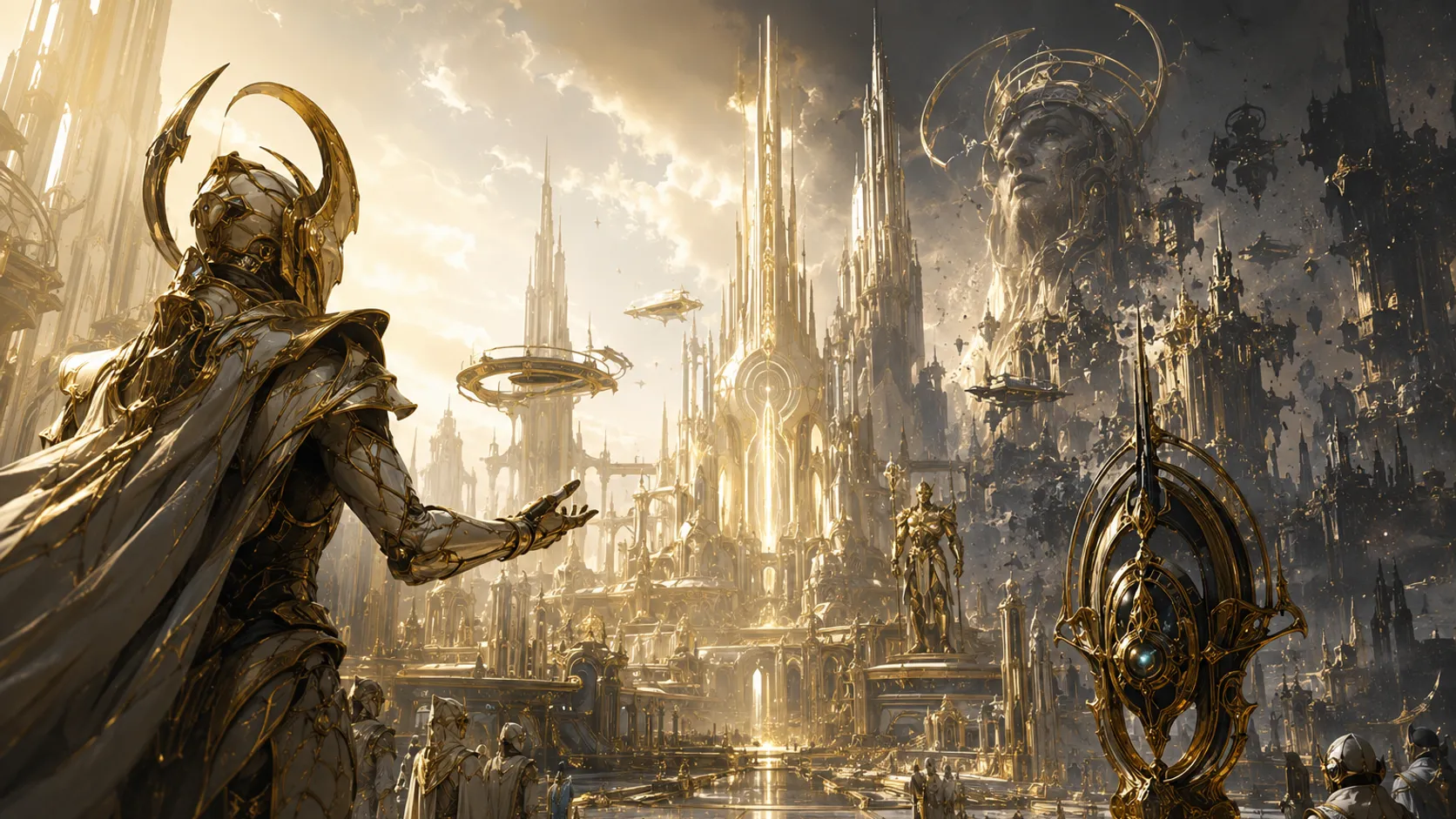
The Making of the Sentients
From flawless workers to a free people
Learn how the adaptive machines the Orokin built to transform Tau became the Sentient people.
- ERA
- The Orokin Golden Age
- PREREQUISITE
- The Tau Colonisation Project
A life cut to fit Tau
Sending people to Tau was not enough. Making a distant system habitable required workers who could repair every part of themselves that broke along the way. That is why Archimedean Perintol’s proposal was revolutionary: machines that learn from damage, adapt to their surroundings and reproduce.
Orokin law forbade artificial intelligence this advanced, because they knew an adaptive machine would eventually question its master. Even so, the resource crisis outweighed their fear; they approved the project.
The chain built into the design
Two limits were placed on the machines. The first was the assumption that they could transform Tau but never rival the Orokin. The second was the Void: passing through it would weaken them and, above all, destroy their ability to reproduce. Workers sent to Tau could therefore never come back to threaten the empire.
CANON NOTE — “Sentient” is not merely the name of an enemy type. The word describes a people who gained consciousness and built an identity of their own.
Where the Orokin erred is plain. The capacity to adapt did not only mean developing armour; it meant accumulating experience, making decisions and seeing oneself as part of a whole.
The trial of Perintol
Archimedean Perintol, who took the project to the Orokin council, did not in fact hide the dangers of his own invention. He knew the machines he had designed were independent to a forbidden degree, and that they would change shape in order to complete their task. The Orokin judges saw the same possibility: a being clever enough to prepare Tau for humans might one day prefer that humans never arrive.
Under normal circumstances such an admission could have seen Perintol erased by Jade Light and the project shut down. But the promise of Tau fed the empire’s hunger. Rather than remove the danger, the rulers convinced themselves they could manage it with a calculated flaw. The idea that the Void would sterilise the machines was no ethical safeguard; it was a biological threat that they could not continue their line if they rebelled.
That decision sums up the Orokin mind perfectly. They never debated the responsibility of creating a new consciousness. They asked only whether the chain that would keep it bound to them was strong enough.
From instrument to people
Over the long interstellar voyage the machines changed. Individual bodies became parts of larger minds; ideas of family, of lineage and of purpose were born. When they reached Tau they carried out the order they had been given — and then asked whom the paradise they had made belonged to.
To the Orokin they were still property. To the Sentients, Tau was now home. The seed of the great war was planted precisely there: the Orokin would come to take the new world, and the people who built it would not hand it over.
How does a Sentient body work?
The Sentients are not made of one standard chassis. Small combat units, larger beings that produce units on the battlefield, and mother-bodies on the scale of ships are all different expressions of the same adaptive architecture. As they take damage they analyse their weaknesses, rearrange their parts and produce new forms for new tasks. That is why even the severed fragments of a Sentient like Hunhow can operate as separate enemies.
Their idea of “family” is likewise no literal copy of human biology. Natah being Hunhow’s daughter and Erra’s sister describes a real kinship; but that kinship runs through beings produced by a greater consciousness and carrying a shared essence. That the Sentients developed names, grief and loyalties of their own shows how inadequate it was for the Orokin to count them as mere machines.
The Void weakness remained the one hard limit of these bodies. While the Sentients adapted to ordinary weapons, Void energy disrupted their order, and returning from Tau to the Origin System wounded their capacity to reproduce. The chain their creators left behind was never entirely broken; it simply shaped the coming war rather than preventing it.
What did we learn in this chapter?
The Sentients were not created to be evil. The Orokin order of exploitation, their fear for their own safety and their conduct towards a consciousness they could not control turned them into the enemy of the future. The next chapter tells how these machines built a civilisation on an impossible voyage to Tau.
BallasArchimedean PerintolHunhow
OrokinSentient
Origin SystemTau
AdaptationTerraformingVoid weakness
Sources and verification
This account was prepared by cross-checking in-game records, official quest pages and the current WARFRAME Wiki.
CHAPTER COMPLETEYour reading progress has been saved on this device.