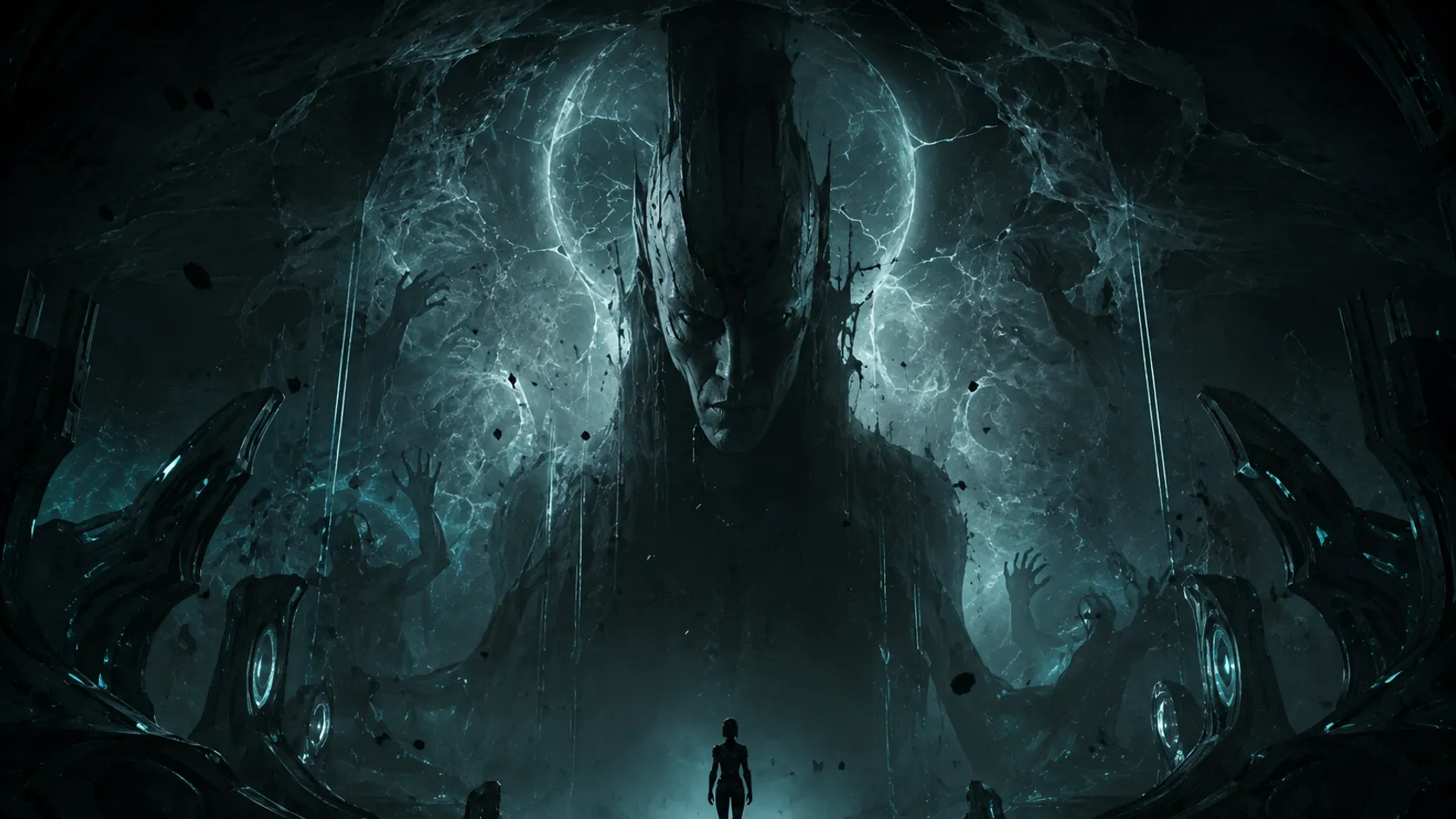
The Man in the Wall / The Indifference
The indifference looking out of the Void
Examine the known appearances of The Man in the Wall and the name The Indifference, keeping firm canon apart from theory.
- ERA
- Beyond the Void
- PREREQUISITE
- Contains spoilers for The New War and Whispers in the Walls
Hey Kiddo
The Man in the Wall never appears in a single form. It came to Albrecht Entrati wearing his own face, and to the Operator as the double of their childhood self. The words “Hey kiddo” carry the bond between a Zariman memory and encounters in the present. The vast stone body, the smile emerging from inside a wall and the severed fingers are all different traces of the same mystery.
A name or a nature?
The Indifference is as much a description as another name: a Void being indifferent to human feeling, whose intent cannot be read. The Whispers in the Walls narrative suggests that love, empathy and connection may matter against it; that does not mean the being is simply “an unfeeling monster”.
LIMIT OF CANON — Whether The Man in the Wall is the Void itself or a separate consciousness born within it has never been settled. This series does not present theory as fact.
The shadow of the bargain
The Operator’s Zariman bargain, Albrecht’s first journey and the finger in the Reliquary Drive all connect to the same being. The Indifference acts through reflection, memory, fear and bargains rather than by direct occupation. The Murmur are its physical echo reaching into reality.
Lotus seeing the vast being at the end of The New War confirms the threat is no longer only in the Tenno’s mind.
The chain of known encounters
Albrecht’s first contact is the earliest known encounter chronologically. The being imitates his face, reaches through the portal, and the severed finger is placed at the centre of Void technology. On the Zariman a similar offer is made to the Operator; the children’s rescue and the bargain are bound together. After The War Within, the double that appears aboard the Orbiter confirms the being is watching the Tenno personally.
The vast stone wall seen at the end of The New War is on a different scale from the earlier small appearances. Lotus perceives it too, which weakens the possibility that the being is only the Operator’s traumatic hallucination. In Whispers in the Walls its physical effect becomes plainer still through the Murmur forces and the Vessels.
Why does it imitate?
Rather than produce a new face, The Indifference usually uses the face and the words of the person before it. The imitation may be a distorted way of building trust, or the result of genuinely being unable to understand human identity. Albrecht’s fear is “which of me came back?”; the Operator’s is “am I still the one who made the bargain?”
That love proves effective against the being should not be reduced to a rule of romantic magic. Love here means a particular bond, mutual recognition and refusing to treat another person as an instrument. What The Indifference cannot imitate is not a face or a voice but the relationship itself. That is why Loid’s bond with Albrecht, the Drifter’s with the Hex, and the Cavia’s with each other all converge on the same central conflict.
Its ultimate aim is still open. There are readings in which it wants to destroy reality, to collect on the bargain, or to understand human experience; current canon confirms none of them as the settled ending. As the story advances, new information will be added to this chapter.
What did we learn in this chapter?
At the end of the third season Ballas is defeated, but an older account has been opened. One end of that account runs to the Zariman bargain, the other to the Drifter growing up in Duviri. Now we cross into the kingdom of the paradox.
The Man in the WallOperatorAlbrecht EntratiLotus
The MurmurTenno
VoidZarimanAlbrecht's Laboratories
The IndifferenceDoppelgängerThe bargain
Sources and verification
This account was prepared by cross-checking in-game records, official quest pages and the current WARFRAME Wiki.
CHAPTER COMPLETEYour reading progress has been saved on this device.