Albrecht Entrati: The First Journey into the Void
The day science first opened the door
Read in detail about Albrecht Entrati's Void research, the bell experiment, and the consequences of meeting his own face on his return.
- ERA
- The Orokin Golden Age
- PREREQUISITE
- Heart of Deimos and Whispers in the Walls
A nothingness that had to be proved
For Albrecht Entrati the Void was no mystical belief but a scientific problem to be measured. In the Orokin world some imagined the Void as a means of travel while others disputed that it existed at all. Albrecht’s experiments showed that this “nothingness” had real effects on energy and on physics.
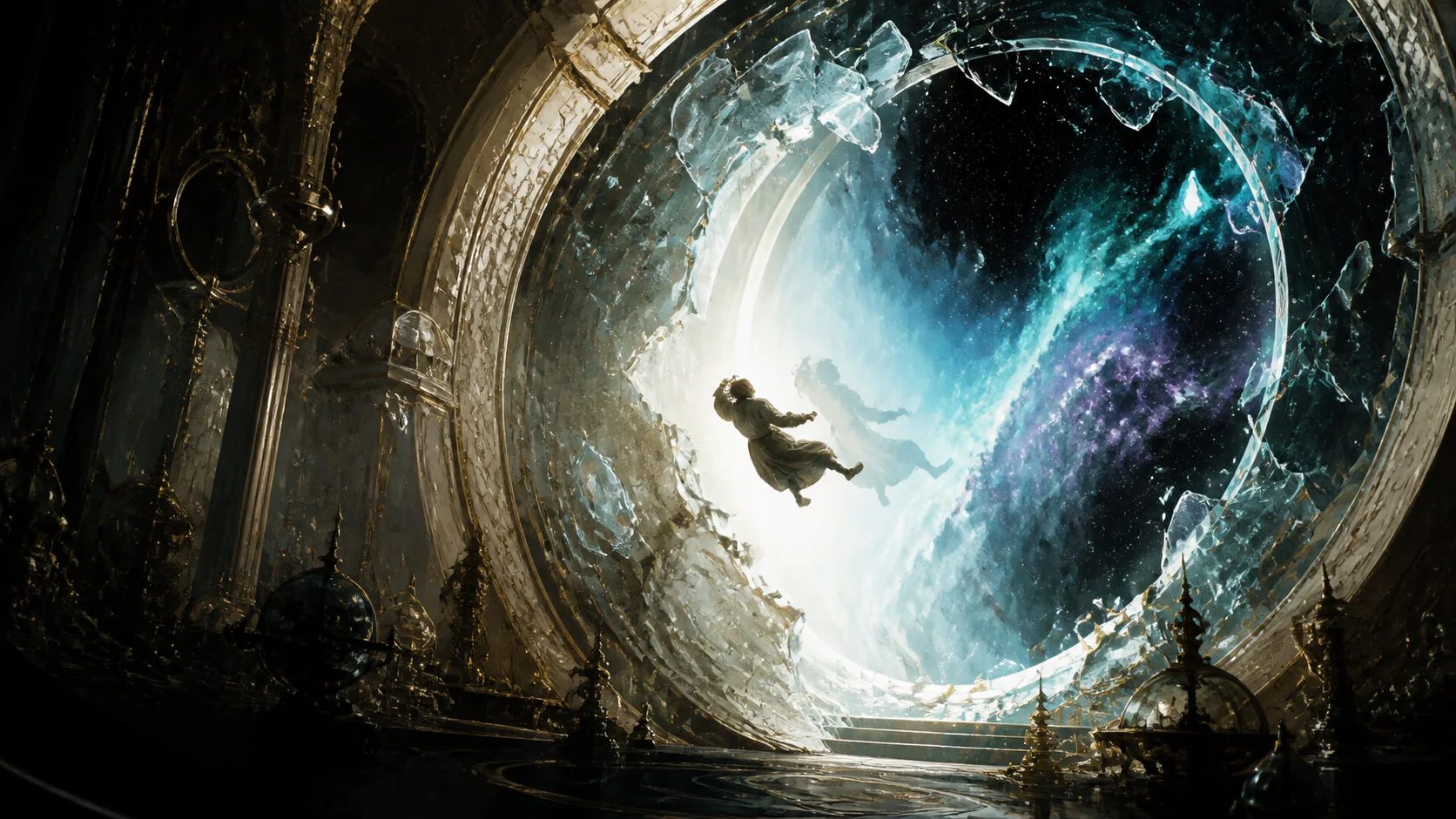
The decisive experiment used a Seriglass bell and a protective apparatus. When the system failed, Albrecht left that protection and fell directly into the Void.
The face on the other side
In the Void he faced not a strange monster but a flawlessly smiling copy of himself. As he fled back to reality the being reached after him; the closing portal severed one of its fingers. That finger later became one of the founding remnants of Reliquary Drive technology.
NARRATIVE — Humanity found the door to the stars. What waited on the other side of it was its own face.
Who came back?
Albrecht lived for years with a terrible question: was it really he who returned through the portal, or the copy? For that reason he stopped moving into other bodies through Continuity. Accepting death was as much an attempt to stop the being reaching the world through an immortal body as it was a moral cleansing.
Later records show he did not simply take fright and hide. He built his laboratories, his Requiem knowledge and a long-term counter-plan. The discovery of the Void made humanity’s journey possible; at the same moment it opened a door to The Indifference.
What the discovery did to the empire
After Albrecht’s experiment the Void stopped being a merely theoretical domain. The Orokin developed that knowledge for interstellar transit, for energy production and later for craft like the Railjack. The empire’s hope of reaching Tau was likewise pinned to a reliable Void bridge. Every technology celebrated as an achievement was the consequence of a severed finger and an opened door.
The Entrati family became the keepers of that legacy through Requiem knowledge, the Isolation Vaults and Necramech research. But rather than explain what he had seen to his family, Albrecht preferred records, symbols and locks. His daughter Euleria carried his absence and his obsession in her own way; the distance inside the family became the everyday price of a cosmic fear.
Giving up Continuity
For the Orokin elite, changing bodies was an ordinary method of immortality. Albrecht’s refusal is a great rupture. He feared that carrying a consciousness he could not vouch for into new bodies would offer The Man in the Wall unlimited life and access. Accepting his own death was therefore a measure to cut the being’s road.
His later journey to 1999, however, complicates the account that “Albrecht simply died”. He moved into another period, continued his work and set up the Kalymos Sequence. What he gave up was not the struggle to live but the Orokin immortality built on stolen bodies. He was less trying to save himself than to draw the threat into the right moment in time.
How should we regard Albrecht’s legacy?
Without him, the Solar Rail and the Tau projects might not have taken the form we know; the same discovery also made contact with The Indifference — and Orokin colonisation — possible. A scientific achievement and the moral worth of its consequences are not the same. Albrecht’s later life is an attempt to correct that duality: trying to close the door he opened, he again folds other people’s lives into his plan.
His story therefore does not say “curiosity was wrong”. The real warning is against mistaking the responsibility of discovery for mere technical control. Even once the Void becomes measurable, there is a will on the other side that forms a relationship; Albrecht learns that before anyone else, and most heavily.
What did we learn in this chapter?
Albrecht is both the scientist who discovered the Void and the first witness to the threat. The next chapter examines why that single encounter turned from a personal fear into a cosmic war.
Albrecht EntratiThe Man in the WallEuleria Entrati
EntratiOrokin
DeimosVoidAlbrecht's Laboratories
Discovery of the VoidThe Seriglass BellLohk
Sources and verification
This account was prepared by cross-checking in-game records, official quest pages and the current WARFRAME Wiki.
CHAPTER COMPLETEYour reading progress has been saved on this device.